
Record monsoon and unusual tropical cyclone formation trigger widespread flooding and landslides across Southeast Asia
South Thailand faced relentless rainfall in late November 2025, shattering decade-old records with 630mm of rain falling over a three-day period (Nation Thailand, 2025). Twelve provinces were left to brave through the impacts from the strong monsoon trough and a low-pressured cell that covered the South and lower South of Thailand (Khaosod English, 2025a), which brought heavy rainfall from 17 November (ReliefWeb, 2025b) and widespread flooding from 20 November onwards. As of 1 December, the Finance Ministry reported that the floods have caused over 500 billion baht ($15.7 million) in economic losses (Bangkok Post, 2025), expecting full restoration of infrastructure to be done by 3 December.
The flooding extended far beyond Thailand, affecting several neighbouring countries across Southeast Asia. Sumatra in Indonesia was hit with swathes of rainfall as Tropical Cyclone Senyar swerved through the Eastern coast, bringing over 400mm of rain to the Aceh Province in 24 hours (New York Times, 2025). Parts of Malaysia also experienced rising waters as Tropical Cyclone Senyar made landfall shortly after (CNN, 2025). Together, these events formed a region-wide flooding episode that was unforeseen, shaped by an unusually active monsoon pattern and multiple overlapping weather systems.
Meteorological overview and timeline
In November 2025, Southeast Asia withstood one of its wettest northeast monsoon seasons in recent years, with record rainfall, floods and landslides across the region. While heavy rains during this part of the year are typical for the region, this year’s monsoon season coincided with two other climate systems that have exacerbated existing torrential rains from monsoon surges and provided fuel for low-latitude tropical cyclones to develop (CNA, 2025a).
The first phenomenon is La Niña, which is characterised by warmer-than-usual sea surface temperatures in the western Pacific Ocean and cooler-than-usual temperatures in the eastern Pacific. This strengthens the winds over the Pacific that push warm water and moisture towards Southeast Asia, resulting in exceptionally heavy rainfall in the region (CNA, 2025a; Al Jazeera, 2025). The presence of La Niña in the Pacific has also coincided with the negative phase of the Indian Ocean Dipole, which brought warmer-than-normal sea surface temperatures near western Indonesia and intensified regional precipitation as well (CNA, 2025a; NASA, 2020).
To add to the mix of simultaneous active climatic systems, a tropical cyclone system developed in the Strait of Malacca brought deluge to parts of Indonesia and Malaysia. Tropical cyclones in low latitudes are “rare” due to the diminished Coriolis force near the equator that sustains the rotation of cyclones (The Straits Times, 2025a). However, in the past five years, Indonesia has experienced several such cyclones that have significantly impacted communities (ABC News, 2025a).
Tropical Cyclone Senyar was brewing in the northern Strait of Malacca from 21 November 2025. Its formation was driven by the intensified northeast monsoon surge generated by the ocean systems, and Typhoon Koto near the Philippines, which allowed winds flowing from the Asian continent to the warmer South China Sea to retain its rotational tendency — even as it approached the Equator (The Straits Times, 2025a; ABC News, 2025a). As the two storms were within proximity of each other, the stronger Koto channelled Senyar in a southeast trajectory along the Strait of Malacca, sustained by the warm seawater. The storm made landfall in Indonesia and Malaysia on 26 and 27 November respectively (The Straits Times, 2025a). This is the third time since records began that a cyclone has tracked across Malaysia (The Straits Times, 2025b).
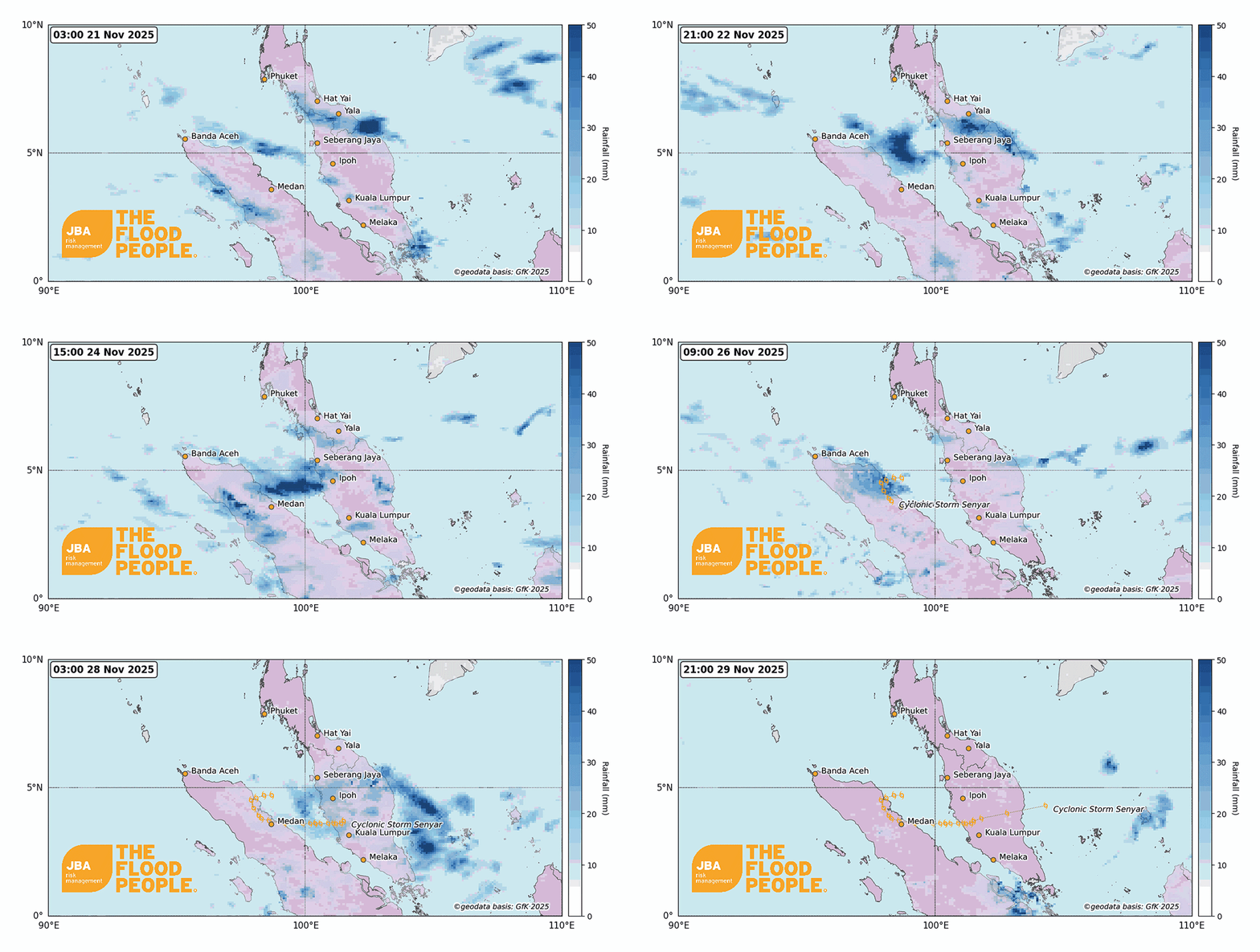
Impact of the floods in Thailand and the affected Southeast Asian countries
As of early December 2025, the flooding and landslides were reported to have claimed the lives of at least 712 in Indonesia, 181 in Thailand, and 3 in Malaysia (ABC News, 2025b). Preliminary assessments estimate economic losses from the November 2025 monsoon floods at over 500 billion baht or 157 billion USD in Thailand alone (Bangkok Post, 2025), and at least US$20 billion across parts of South and Southeast Asia (The Straits Times, 2025c).
Thailand
The southern provinces of Thailand witnessed high volumes of rainfall, with Hat Yai reaching a daily total of 370.2mm on 21 November 2025, which is estimated to be a 300-year rainfall. Meanwhile, Narathiwat recorded 624.2mm on 22 November 2025, and Yala hit 347.2mm on 23 November 2025 (Thailand Meteorological Department, 2025; World Meteorological Organization, 2025).
As of 3 December, Thailand’s Department of Disaster Prevention and Mitigation (DDPM) reported that approximately 1.7 million people across 52 districts in South Thailand were still affected by the floods, with more than 700,000 households affected (not including Hat Yai) (The Nation, 2025).
By 4 December 2025, Thailand had officially reported at least 267 fatalities across eight inundated provinces, with more than half coming from Hat Yai (The Star, 2025). With Hat Yai being a tourist hub, a significant loss is seen across the tourism sector and hotel industry; about 50 billion baht or 1.56 million USD has been lost from cancelled bookings and property damage. More than 300 hotels were forced to close or affected by cancellations (Khaosod English, 2025b). The export sector, especially in high-value commodities, is also estimated to see a potential loss of up to 400 million USD a month as manufacturing was also impaired (The Straits Times, 2025c).
Malaysia
As soon as the floods hit Malaysia, over 15,000 people had taken refuge in 90 evacuation centres set up by 24 November 2025. At the peak, 37,000 evacuees were spread across more than 200 relief centres nationwide. Kelantan was hit the hardest, accounting for 8,228 of the 11,009 affected people (CNA, 2025c). Low-lying villages in Kelantan, Perlis, and Kedah were submerged for days, leaving homes structurally damaged and families stranded.
The scale of the disaster was evident in the rivers, where 10 major rivers reached dangerous levels by 26 November 2025. Sungai Padang Terap surged at 4.55 metres, Sungai Perik hit 14.53 metres, and Wang Tepus at 10.33 metres, turning familiar landscapes into vast lakes (MalayMail, 2025). Losses incurred reached up to 10.3 million USD, with the majority of the damage involving paddy crops (Malaysia Sun, 2025).
Indonesia
According to the latest statistics from the National Disaster Management Agency (BNPB), there have been nearly 900 deaths, with 521 persons missing and 4,200 wounded. About 30% of deaths came from Agam and Tapanuli Tengah districts. The number of non-residential buildings estimated to be damaged by floods is nearly 2,500, while more than 121,000 residential buildings have been damaged or destroyed (BNPB, 2025). The Center of Economic and Law Studies in Jakarta estimates losses of over US$4 billion or 0.29% of Indonesia’s Gross Domestic Product, due to damage to infrastructure, loss in income and agricultural yield (The Straits Times, 2025c).
Deforestation in the Sumatra region has been singled out as an aggravating factor of flooding and landslides in nearby villages (ABC News, 2025c). Felled logs became floating barricades that swept through villages downstream of mining and logging operations. The exposed ground no longer absorbs as much water, surface runoff increases and slopes become unstable without roots to hold the soil together (The Conversation, 2025; New York Times, 2025).
Notable historical events
Southeast Asia has a long history of severe monsoon-related flooding, and the 2025 event is another example that fits into the regional pattern for the impact on countries during the monsoon season. However, what sets this year apart is not merely the scale of the flooding in Thailand, Malaysia, and Sumatra, but the rare formation of a tropical cyclone at such low latitudes — an event that has occurred only a handful of times in recorded history.
While this level of flooding has been record-breaking, residents in this region are no strangers to severe flood events. Prior to 2025, the 2010 Hat Yai flood held the benchmark of 428mm for a similar three-day period (Nation Thailand, 2025). Thailand has also experienced major monsoon-driven disasters in past decades, such as the 2011 Thailand flood, which was fuelled by a strong monsoon and 4 tropical storms linked to the prolonged La Niña event of 2010-2011 (Gale, 2014). Malaysia has also faced significant monsoon-driven disasters, such as the 2014 Kelantan floods, which set the record rainfall of 1295mm from 21 December 2021 to 23 December 2021 (National Library of Medicine, 2015).

Similar conditions have affected neighbouring countries as well. Indonesia experienced its heaviest monsoon rainfall recorded in decades in January 2020 (CNN, 2020). Cambodia, Loas, and Vietnam were struck by a succession of tropical storms in October 2020, causing multi-day rainfall and landslides (The New Humanitarian, 2020). Together, these events show that extreme monsoon rainfall has been a recurring challenge across Southeast Asia and will continue to be a challenge that should be mitigated.
Climate change
Climate change is likely to have worsened the impact of this monsoon season on Southeast Asia, amongst other factors such as deforestation, failures in flood defences, and insufficient investment in disaster preparedness (The Straits Times, 2025c). According to research firm BMI, Southeast Asia will experience more “compound disasters” and greater damage will be seen in the coming years.
Despite that, many countries in Southeast Asia still lack strong early-warning systems, according to Stephen Turton, adjunct professor at Central Queensland University’s environmental geography division (CNA, 2025b). Turton called the region a global warming hotspot, where warming oceans are supercharging the global water cycle. The evidence of heavier rainfall and flash floods linked to monsoons, typhoons, and tropical cyclones validates the severity of the region being a climate risk. Such events have now made cyclones, typhoons, and floods less than a one-in-a-lifetime event and more of a yearly repetition.
Conclusion
While the occurrence of floods is bound to be more frequent as the climate changes, Southeast Asia is particularly at risk of “compound disasters” where multiple severe events occur in close succession (The Straits Times, 2025c). Population demographics in the region are also rapidly changing, with an increasing proportion of the population residing in at-risk regions.
Despite the pressing need for countries to account for the increased risk and vulnerability to such extreme flood events, steps towards climate resiliency continues to lag in Southeast Asia as economic growth is often prioritised over long-term planning and adaptation measures (The Straits Times, 2025c). Yet, this is precisely the reason why decisions for adaptation and disaster prevention matters now more than ever as communities build back stronger and become more resilient.
This report is accompanied by a flood footprint for the event, detailing extents and depths of the flooding in areas affected in Thailand. Download it via our Client Portal or request a copy by emailing eventresponse@jbarisk.com.


