Cylone Ditwah: November 2025

I Stock 2249519485 Cyclone Ditwah FOR WEB

Cyclonic storm Ditwah causes catastrophic flooding in Sri Lanka

In late November 2025, a cyclonic storm known as “Cyclone Ditwah” emerged from the warm waters of the Bay of Bengal and made landfall on the eastern coast of Sri Lanka on 27 November 2025 just before 12:00 UTC (ReliefWeb, 2025a). The landfall unleashed torrential rainfall, widespread flooding, and deadly landslides that overwhelmed communities across 25 districts (UNFPA, 2025; WHO, 2025). 

In just eight to nine days, about one-fifth of Sri Lanka became inundated, with 2.3 million Sri Lankans affected, of whom more than 60% were from Colombo and Gampaha (UNDP, 2025). As of 11 December 2025, more than 600 fatalities were reported, with economic losses reaching around US$7 billion (The Straits Times, 2025). The impact of Cyclone Ditwah was reported as one of the fastest crises to unfold in a short span of time (UNDP, 2025).

Overview and timeline

Cyclone Ditwah began as a well-marked low-pressure area just off the south-eastern coast of Sri Lanka on 26 November 2025. As the system moved into the Bay of Bengal, it encountered atmospheric and oceanic conditions allowing it to rapidly intensify into a tropical depression.  

By the next day, the system had strengthened and developed into Cyclone Ditwah, making landfall with maximum sustained winds of approximately 65 km/h. The cyclone continued its passage northward inland and centred over northern Sri Lanka on 28 November 2025 (06:00 UTC), maintaining sustained winds of 65 km/h (ReliefWeb, 2025a). It continued northward over the Bay of Bengal until 29 November 2025 (20:00, UTC), where it slightly weakened and was reduced to a tropical depression on 30 November 2025 (Zoom Earth, 2025). 

This cyclone formation occurred right in the heart of the “Maha” season (September-March), which coincides with the Northeast Monsoon. This season is characterised as one that brings heavy rainfall to the northern and eastern parts of Sri Lanka (FAO). While the “Maha” season is important for agriculture, such as replenishing the water reservoirs and supporting crop growth of staples like rice to sustain the population (Lanka Tour Experts), it also increases the vulnerability to flooding, strong winds, and storm-related hazards.  

According to the Department of Meteorology’s report on 28 November 2025, the observed 24-hour rainfall for several districts exceeded 300mm, which includes Vavuniya, Nuwara Eliya, Kandy, Anuradhapura, and Mullaitivu (Disaster Management Centre, 2025). A local hydrology professor estimated the rainfall received on this day as nearly 10% of Sri Lanka’s annual average landfall which has significantly strained the catchments’ capacity (The Diplomat, 2025).
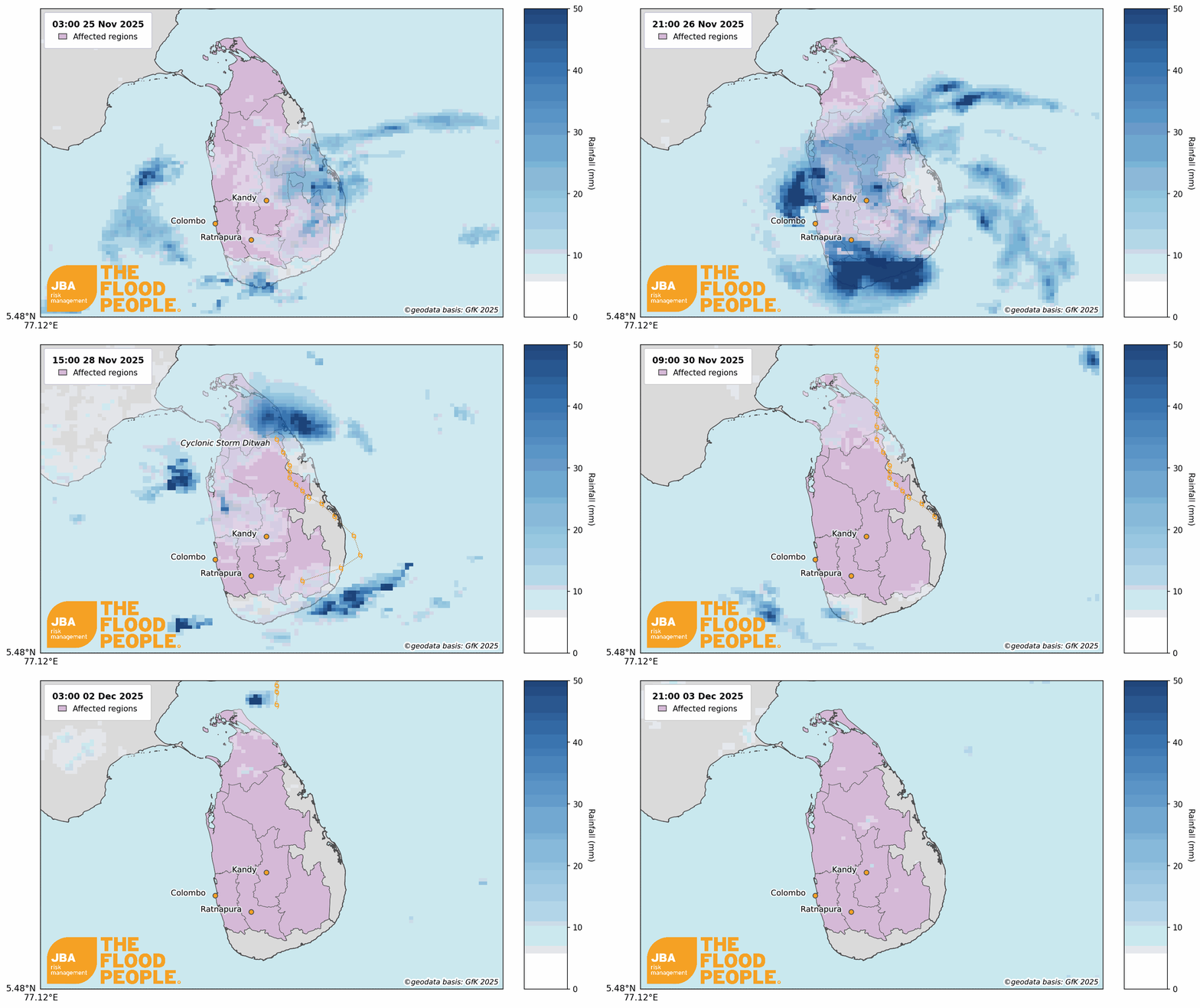
Map showing rainfall over Sri Lanka during Cyclonic Storm Ditwah with affected regions highlighted.
Figure 1: Animation of rainfall over Sri Lanka from 25 November 2025 to 3 December 2025 with Cyclonic Storm Ditwah. Rainfall data source: NASA GPM 3-hour rainfall accumulation (2025). Typhoon track data source: IBTrACS (2025). Animation produced by JBA Risk Management (2025).

Impact

Cyclone Ditwah’s passage through Sri Lanka resulted in one of the most severe natural disasters to affect the island in decades. Geospatial analysis from the United Nations Development Programme (UNDP) shows about 1.1 million hectares were submerged, and floodwaters reached nearly 720,000 buildings and over 16,000 kilometres of roads. In the more hill-bound areas, around 1,200 landslides were triggered, isolating at-risk communities by disrupting access to essential services (UNDP, 2025).

Central Sri Lanka was particularly hit hard, threatening Sri Lanka’s tea and vegetable industry. The cyclone-induced floods and landslides uprooted many fully grown tea plantations, destroying roads and railway lines, and delaying the delivery of essentials, thereby rendering thousands of plantation workers homeless (Al Jazeera, 2025). As the second largest source of export revenue, preliminary estimates predict an output decline of about 35% for the tea industry in Sri Lanka.

As of 12 December 2025, the Disaster Management Centre reported that 5,588 houses were completely destroyed, 87,496 sustained partial damage, and 866 evacuation centres were established to accommodate 84,674 displaced individuals (ReliefWeb, 2025b).

Government officials have estimated a significant economic loss at USD$6-7 billion, which is nearly 3-5% of the nation’s Gross Domestic Product and surpasses the country’s foreign reserves (The Diplomat). This prompted the government to make a request to International Monetary Fund (IMF) of US$200 million for disaster recovery and support (Institute of South Asian Studies, 2025).

Notable historical events

Sri Lanka and the broader Bay of Bengal region have a long history of weather-related disasters driven by cyclones, monsoons, and extreme rainfall events. Although direct cyclone landfalls on Sri Lanka are extremely rare, the island has experienced severe flooding, landslides, and storm-related damage from systems that formed in the same basin as Cyclone Ditwah.

Summary table of significant cyclone and flood events in Sri Lanka and their impacts.

Climate change

Cyclone Ditwah occurred during the Maha season, when background conditions in Sri Lanka are already favourable for prolonged rainfall and elevated flood risk. In this context, climate change is relevant primarily through its influence on extreme precipitation rather than on cyclone frequency or intensity. Warmer atmospheric conditions increase the capacity of the air to hold moisture, which can intensify rainfall when weather systems develop.

The World Weather Attribution team analysed recent extreme rainfall and flooding in Sri Lanka and found evidence of an increase in extreme five-day rainfall totals associated with approximately 1.3 °C of global warming to date (World Weather Attribution, 2025). However, their analysis also highlights substantial uncertainty, including limited agreement across climate models, which prevents a robust quantitative attribution of the observed rainfall changes, and therefore the resulting flood impacts, directly to climate change. The study further notes that large-scale climate variability, including ENSO and Indian Ocean Dipole conditions, as well as local exposure and vulnerability, play an important role in shaping flood outcomes. 

For Cyclone Ditwah, this implies that while physical mechanisms linking warming to heavier rainfall are well established, the severity of flooding resulted from a combination of meteorological conditions, seasonal hydrological stress, and local catchment and infrastructure characteristics. Climate change may have increased the likelihood of intense rainfall, but it is not possible to isolate its contribution to the observed impacts for this event alone. 

Conclusion

Cyclone Ditwah was a moderate cyclonic system that nonetheless produced widespread flooding across Sri Lanka during the Maha season, illustrating how seasonal rainfall patterns and hydrological conditions can amplify impacts even in the absence of extreme cyclone intensity. The event underscores Sri Lanka’s sensitivity to prolonged heavy rainfall, particularly when rivers, reservoirs and soils are already close to capacity. 

As climate change continues to influence rainfall extremes, future flood risk in Sri Lanka will depend not only on changes in hazard but also on exposure, vulnerability, and preparedness. Strengthening early warning systems, improving drainage and river management, and incorporating flood risk into infrastructure and land-use planning remain key measures for reducing future losses. Cyclone Ditwah provides a recent example of how these factors interact, offering lessons for managing flood risk under both current and evolving climate conditions.

This report is accompanied by a flood footprint for the event, detailing extents and depths of the flooding in areas affected in Sri Lanka. Download it via our Client Portal or request a copy by emailing eventresponse@jbarisk.com.   

Join our mailing list

Never miss an update about our products and services, company news and event response data.

References

Al Jazeera, 2025. ‘Like wastelands’: Sri Lanka tea plantations suffer Cyclone Ditwah’s wrath. [Online]. Available at: https://www.aljazeera.com/news/2025/12/10/like-wastelands-sri-lanka-tea-plantations-suffer-cyclone-ditwahs-wrath [Accessed 11 December 2025]

Asian Disaster Reduction Center (ADRC), 2008. Sri Lanka: Tropical Cyclone: 2008/11/26. [Online]. Available at: https://www.adrc.asia/view_disaster_en.php?lang=&KEY=1244 [Accessed 15 December 2008]

Cable News Network (CNN), 2017. Sri Lanka floods: Battle to rescue stranded as death toll tops 180. [Online]. Available at: https://edition.cnn.com/2017/05/29/asia/sri-lanka-floods/index.html [Accessed 15 December 2025]

Damage Management Centre (DMC), 2020. Situation Report – Sri Lanka. [Online]. Available at:  https://www.dmc.gov.lk/images/dmcreports/Situation_Report_on_2020__1607346356.pdf [Accessed 12 December 2025]

Food and Agriculture Organization of the United Nations (FAO). Country Activities. [Online]. Available at: https://www.fao.org/in-action/knowat/country-activities/ru/ [Accessed 15 December 2025]

India Meteorological Department Ministry of Earth Sciences Government of India, 2020. Cyclonic Storm, „BUREVI‟ over the Bay of Bengal (30th November - 05th December 2020): A Report [Online]. Available at: https://rsmcnewdelhi.imd.gov.in/uploads/report/26/26_0522b4_burevi.pdf [Accessed 12 December 2025]

India Meteorological Department Ministry of Earth Sciences Government of India, 2008. REPORT ON CYCLONIC DISTURBANCES OVER NORTH INDIAN OCEAN DURING 2008. [Online]. Available at: https://rsmcnewdelhi.imd.gov.in/report.php?internal_menu=Mjc= [Accessed 15 December 2025]

International Organization for Migration, 2017. Sri Lanka Floods and Landslides 2017. [Online]. Available at: https://www.iom.int/sites/g/files/tmzbdl486/files/situation_reports/file/Sri-Lanka-Floods-IOM-Situation-Report-2-5June2017.pdf [Accessed 12 December 2025]

Lanka Tour Experts. Yala and Maha Seasons in Sri Lanka. [Online]. Available at: https://www.lankatourexperts.com/yala-season-and-maha-season-in-sri-lanka/ [Accessed 15 December 2025]

National Aeronautics and Space Administration (NASA), 2017. The Monsoon Inundates Sri Lanka. [Online]. Available at: https://science.nasa.gov/earth/earth-observatory/the-monsoon-inundates-sri-lanka-90322/ [Accessed 15 December 2025]

United Nations Office for the Coordination of Humanitarian Affairs (OCHA), 2016. Sri Lanka: Floods and Landslides Situation Report No. 2 (as of 26 May 2016). [Online]. Available at: https://www.unocha.org/publications/report/sri-lanka/sri-lanka-floods-and-landslides-situation-report-no-2-26-may-2016 [Accessed 15 December 2025]

ReliefWeb, 2025a. Tropical Cyclone Ditwah – Nov 2025. [Online]. Available at: https://reliefweb.int/disaster/tc-2025-000218-lka [Accessed 11 December 2025]

ReliefWeb, 2025b. Situation Report - Sri Lanka 12th December 2025 at 0900hrs. [Online]. Available at: https://reliefweb.int/report/sri-lanka/situation-report-sri-lanka-12th-december-2025-0900hrs [Accessed 12 December 2025]

ReliefWeb, 2017. Bangladesh: Cyclone Roanu - Emergency Plan of Action Final report (MDRBD016). [Online]. Available at: https://reliefweb.int/report/bangladesh/bangladesh-cyclone-roanu-emergency-plan-action-final-report-mdrbd016 [Accessed 15 December 2025]

ReliefWeb, 2012. Tropical Cyclone Nilam: Maldives, Sri Lanka and India - Situation Report (SR-1), 01 November 2012. [Online]. Available at: https://reliefweb.int/report/india/tropical-cyclone-nilam-maldives-sri-lanka-and-india-situation-report-sr-1-01-november [Accessed 15 December 2025]

ReliefWeb, 2008. Tropical Cyclone Nisha - Nov 2008. [Online]. Available at: https://reliefweb.int/disaster/tc-2008-000237-lka [Accessed 15 December 2025]

Science and Development Network, 2016. Cyclone Roanu exposed Sri Lankan disaster response gaps. [Online]. Available at: https://www.scidev.net/global/column/cyclone-roanu-sri-lankan-disaster/ [Accessed 15 December 2025]

Tamil Nadu News, 2020. 7 Dead As Burevi Weakens Into Depression But Batters Southern Tamil Nadu. [Online]. https://www.ndtv.com/tamil-nadu-news/burevi-news-tamil-nadu-7-dead-as-burevi-weakens-into-depression-but-batters-southern-tamil-nadu-2334640 [Accessed 12 December 2025]

The New Indian Express, 2012. 'Nilam' may cause widespread rainfall in Kerala. [Online]. Available at: https://www.newindianexpress.com/states/kerala/2012/Oct/31/nilam-may-cause-widespread-rainfall-in-kerala-420368.html [Accessed 15 December 2025]

The Straits Times, 2025. Deadly November Asian storms ‘supercharged’ by climate change, researchers say. [Online]. Available at: https://www.straitstimes.com/asia/se-asia/deadly-november-asian-storms-supercharged-by-climate-change-researchers-say [Accessed 11 December 2025]

United Nations Development Programme (UNDP), 2025. One-fifth of Sri Lanka inundated by Cyclone Ditwah, UNDP analysis. [Online]. Available at: https://www.undp.org/asia-pacific/press-releases/one-fifth-sri-lanka-inundated-cyclone-ditwah-undp-analysis [Accessed 11 December 2025]

United Nations International Children’s Emergency Fund (UNICEF), 2020. Cyclone Burevi Situation Update #1. [Online]. Available at: https://www.unicef.org/srilanka/stories/cyclone-burevi-situation-update-1 [Accessed 12 December 2025]  

United Nations Population Fund (UNFPA), 2025. UNFFPA Cyclone Ditwah Situation Report (25 November – 7 December 2025). [Online]. Available at: https://www.unfpa.org/resources/unfpa-cyclone-ditwah-situation-report-25-november-%E2%80%93-7-december-2025 [Accessed 11 December 2025]

World Health Organization (WHO), 2025. Cyclone Ditwah 2025. [Online]. Available at: https://www.who.int/srilanka/emergencies/cyclone-ditwah-2025 [Accessed 11 December 2025]

World Weather Attribution, 2025. Increasing heavy rainfall and extreme flood heights in a warming climate threaten densely populated regions across Sri Lanka and the Malacca Strait. [Online]. Available at: https://www.worldweatherattribution.org/increasing-heavy-rainfall-and-extreme-flood-heights-in-a-warming-climate-threaten-densely-populated-regions-across-sri-lanka-and-the-malacca-strait/ [Accessed 15 December 2025]

Zoom Earth, 2025. [Online]. Available at: https://zoom.earth/storms/ditwah-2025/ [Accessed 11 December 2025]

IBTrACS, 2025. International Best Track Archive for Climate Stewardship. [Online]. Available at: https://www.ncei.noaa.gov/products/international-best-track-archive [Accessed 15 December 2025].

NASA Global Precipitation Measurement (GPM), 2025. Precipitation Data Directory. [Online]. Available at: https://gpm.nasa.gov/data/directory [Accessed 15 December 2025]  

Disaster Management Centre, 2025. Warning for Cyclonic storm in the vicinity of Sri Lanka. [Online]. Available at: https://www.dmc.gov.lk/images/dmcreports/Warning_for_Cyclonic_storm_in_the_vicinity_of_Sri_Lanka_Issued_at_11__1764313192.pdf. [Accessed 15 December 2025]  

The Diplomat, 2025. As Cyclone Ditwah Recedes, Sri Lanka Confronts the Failures That Made a Disaster Inevitable. [Online]. Available at: https://thediplomat.com/2025/12/as-cyclone-ditwah-recedes-sri-lanka-confronts-the-failures-that-made-a-disaster-inevitable/. [Accessed 15 December 2025]  

Institute of South Asian Studies, 2025. Cyclone Ditwah and the Politics of Recovery in Sri Lanka. [Online]. Available at: https://www.isas.nus.edu.sg/papers/cyclone-ditwah-and-the-politics-of-recovery-in-sri-lanka/ [Accessed 15 December 2025]  

Related event responses

View all event responses

Aerial view of a flooded neighbourhood with homes surrounded by floodwater.

Southeast Asia floods: November 2025

20th November

South Thailand faced relentless rainfall in late November 2025, shattering decade-old records with 630mm of rain falling over a three-day period. Twelve provinces were left to brave through the impacts from the strong monsoon trough and a low-pressured cell that covered the South and lower South of Thailand.

Read more

I Stock 2246918596 Storm Claudia Nov 25

Storm Claudia: November 2025

20th November

Storm Claudia brought record-breaking rainfall and flooding across parts of England, Wales, Spain and the Canary Islands, triggering a major incident and numerous flood alerts. In Portugal, the storm sadly caused some fatalities.

Read more

I Stock 2243748262 Hurricane Melissa Satellite

Hurricane Melissa: October 2025

28th October

Hurricane Melissa made landfall in Jamaica on 28 October 2025 as a Category 5 hurricane with 185 mph (295 km/h) sustained winds and a central pressure under 900 mb, and is among the strongest Atlantic Hurricanes on record.

Read more