Thailand floods: September 2026

A partially submerged car on a flooded street, with people wading through floodwater and others travelling by boat.

Bangkok underwater: Severe monsoon flooding in Thailand

In September 2026, severe monsoon-driven flooding affected large areas of Thailand, causing widespread disruption to communities, infrastructure, and transport networks. The flooding followed a period of intense and persistent rainfall during the peak of the country’s southwest monsoon season. Unlike typical river flooding, the event resulted from intense, localised rainfall that exceeded the capacity of Bangkok’s drainage and canal systems (Nestopa.com, 2026). The severity of this urban pluvial flood event prompted authorities in Bangkok to declare a city-wide disaster after nearly 48 hours of intense rainfall overwhelmed the city's drainage systems and caused extensive inundation.

Overview and timeline

According to the Department of Disaster Prevention and Mitigation (DDPM), flooding outside Bangkok affected more than 500,000 households and approximately 1.7 million people across 27 provinces (CNA, 2026a). Since 16 September, eight flood-related fatalities have been reported in the eastern provinces of Sa Kaeo, Chanthaburi, and Saraburi. The flooding displaced thousands of residents, many of whom sought refuge in temporary shelters, while schools were closed and transport networks experienced significant disruption.

Prior to the severe flooding in Bangkok, a strong convective low-pressure system moved westward from Vietnam and Cambodia along the monsoon trough. On 22 September, the Thai Meteorological Department warned of heavy to very heavy rain across Bangkok and surrounding provinces between 23 and 27 September (Thai Meteorological Department, 2026a). The system subsequently enhanced monsoonal moisture and rainfall intensity across the region, contributing to the widespread flooding (Nestopa.com, 2026). As of 28 September 2026, parts of Bangkok had remained flooded for four consecutive days, although rainfall had begun to ease as the low-pressure system moved westward. Approximately 329,000 households, representing around 700,000 people, had been affected across the capital (Kothari, 2026).

The flooding affected 93 roads across Bangkok, with critically elevated water levels in five major canals identified as a key factor exacerbating the event (The Nation Editorial Team, 2026). Overflowing canals, combined with intense rainfall, overwhelmed the city's drainage network and contributed to widespread inundation across affected districts.

While flooding impacted all 50 districts of Bangkok, the most severe effects were concentrated in the eastern and northern parts of the city, where intense rainfall and critically high canal water levels resulted in widespread inundation and disruption.

Table summarising flood impacts across four Bangkok districts during the September 2026 floods, including rainfall and drainage issues.

What caused the Bangkok flooding?

The severe flooding seen in Bangkok was the result of a combination of meteorological and urban drainage factors. Prior to the extreme rainfall that affected Bangkok in late September, the Thai Meteorological Department forecast heavy rain in 38 provinces from 16 September onwards (Thai Meteorological Department, 2026b). These earlier rainfall events contributed to saturated ground conditions and elevated water levels in several rivers, canals, and drainage networks. During late September, an active southwest monsoon supplied sustained atmospheric moisture across Thailand, while a strong low-pressure system moved westward from Vietnam and Cambodia along the monsoon trough, enhancing rainfall across the region. 

The September event was primarily a pluvial flood driven by intense localised rainfall, unlike a typical river flood caused by rivers overtopping their banks. Rain began on 24 September and continued for almost 48 hours, with some eastern districts receiving close to 300 mm of accumulated rainfall (The Straits Times, 2026). This exceeded the design capacity of Bangkok’s drainage system, which was estimated to handle approximately 80 mm of rainfall per hour following drainage upgrades in June 2026 (Tuengtin, W., 2026). As a result, stormwater accumulated faster than it could be removed, leading to widespread flooding across the city.
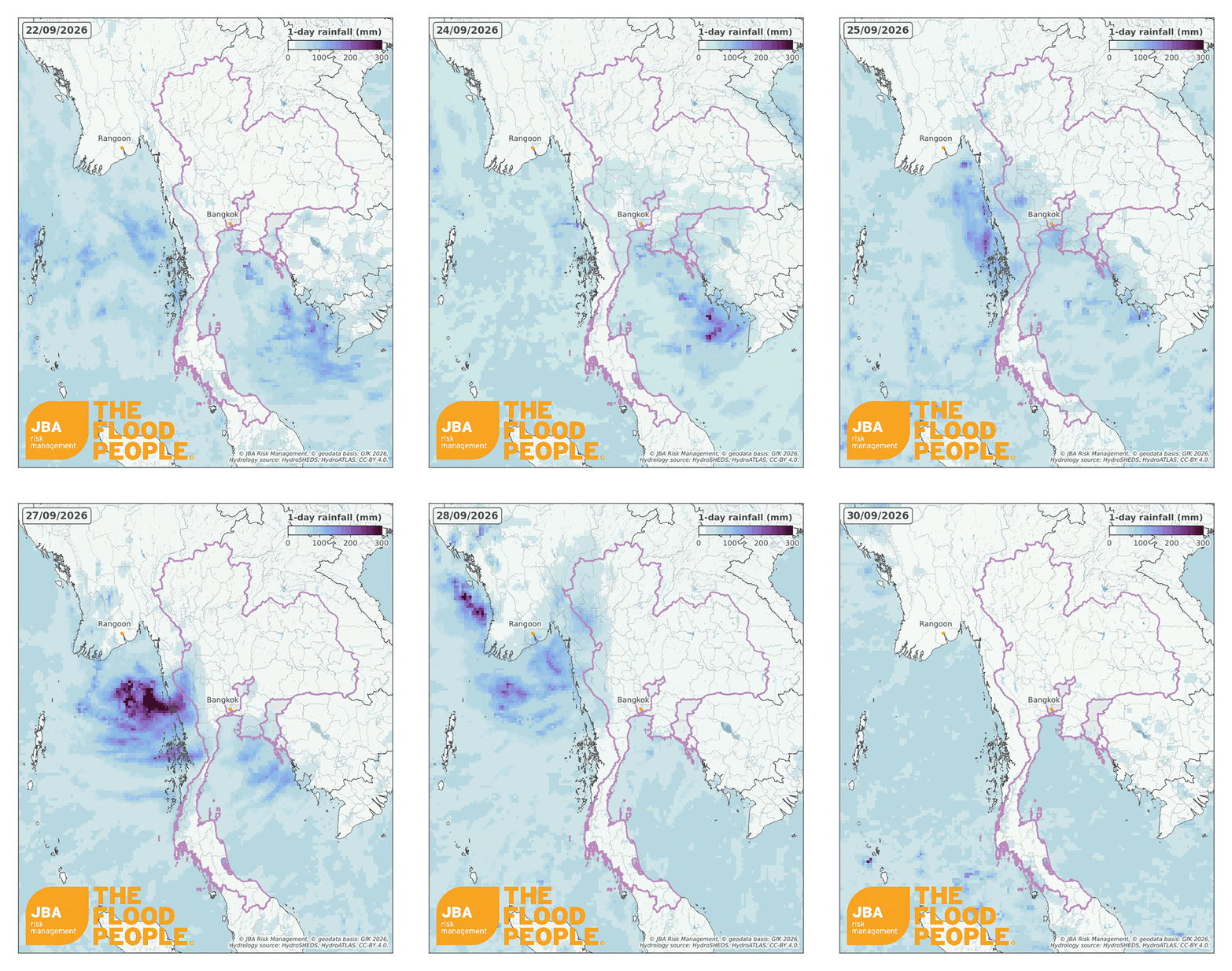
Animated map showing daily rainfall patterns across Thailand, including Bangkok, from 22 to 30 September 2026.
Figure 1: Animation of rainfall over Bangkok from 22 to 30 September 2026. Rainfall data source: NASA GPM 1-day rainfall accumulation (2026).
Map showing 24-hour rainfall totals at five Bangkok locations and major canals affected by flooding in September 2026.
Figure 2: Key canals overwhelmed by the burst of rainfall along with the 24-hour rainfall from 25 to 26 September 2026. (Data source: Canal locations obtained from the Humanitarian Data Exchange contributed by the Humanitarian OpenStreetMap Team [SS2.1][GS2.2](2026). Rainfall data from the Bangkok Metropolitan Administration (2026)).

Flood conditions were further exacerbated as water levels rose in 5 major canals: Prem Prachakon Canal, Lat Phrao Canal, Saen Saep Canal, Prawet Burirom Canal, and Siri Watthana Canal. These canals reached critical levels and were unable to efficiently convey excess runoff. The Bangkok Metropolitan Administration reported that the city’s pumping stations were operating at full capacity, drawing about 1,200 cubic metres per second combined (CNA, 2026b). Drainage efforts were further hindered by additional inflows from neighbouring provinces, including Nonthaburi and Pathum Thani, as well as elevated flows within the Chao Phraya River system following the heavy rainfall in northern Thailand (Online Reporters, 2026). Increased flows within the Chao Phraya River basin also led to flooding in Uthani Thani, Chai Nat, and Nakhon Sawan. 

Notable historical events

Thailand has experienced several notable flood events over time, with each event highlighting the country's exposure to hydrometeorological hazards. While the September 2026 floods alone do not establish a long-term pattern of risk, their occurrence following the severe flooding in 2025 suggests that Bangkok may face increasing pressure from extreme rainfall events. This emphasises the need for proactive adaptation measures, enhanced drainage infrastructure, integrated flood management, and improved preparedness to mitigate future flood risk.

Table comparing the causes and impacts of major Bangkok flood events in 1995, 2017, 2021 and 2025.

Industry insight

Bangkok and 26 other Thai provinces faced potential losses of 2.283 billion baht in lost economic activity due to business interruption caused by the flooding (Watson, 2026). Total economic losses from the five-day event could range from 5.896 billion to 20.635 billion baht, equivalent to approximately 0.03% to 0.11% of Thailand's annual Gross Domestic Product (GDP). Bangkok was expected to account for nearly 7.014 billion baht of these losses, representing more than 50% of the base-case estimate of annual GDP. Estimated losses of 69.1 billion baht were expected across Thailand's agricultural supply chain, where losses affected farms and consumers (The Nation Editorial Team, 2026).

Conclusion

As floodwaters gradually recede, the September 2026 event leaves important lessons for Bangkok and the wider metropolitan region. Ultimately, the floods are not simply a story of heavy rainfall, but a test on how to manage flood water in an increasingly complex urban environment. Greater emphasis is needed on integrated flood management and the challenges that the city may face in the future. As Bangkok continues to grow and develop, building resilience through improved drainage is important, but so is effective water management and community preparedness.

This report is accompanied by a flood footprint for the event, detailing extents and depths of the flooding in areas affected. Download it via our Client Portal or request a copy by emailing eventresponse@jbarisk.com. 

Join our mailing list

Never miss an update about our products and services, company news and event response data.

References

Bangkok Metropolitan Administration, 2026. Rainfall Measurement System. [Rainfall dataset]. Available at: https://weather.bangkok.go.th/rain/ [Accessed 5 October 2026]

CNA, 2026a. Eight dead in Thailand floods since mid-September. [Online]. Available at: https://www.channelnewsasia.com/asia/thailand-floods-deaths-heavy-rain-disaster-6414981 [Accessed 29 September 2026]

CNA, 2026b. Bangkok declares disaster after homes flooded, roads submerged by heavy rain. [Online]. Available at: https://www.channelnewsasia.com/asia/bangkok-heavy-rain-canals-roads-flooding-disaster-6412356 [Accessed 1 October 2026]

Euronews, 2017. Bangkok hit by flash floods. [Online]. Available at: https://www.euronews.com/2017/10/15/bangkok-hit-by-flash-floods [Accessed 12 October 2026]

Geoinformatics Center - AIT, 2021. Thailand flood 2021, ArcGIS StoryMaps. [Online]. Available at: https://storymaps.arcgis.com/stories/726c467147d44b57b62c39f9fe30430a [Accessed 12 October 2026]

GLOBE Task Team and others, 1999. The Global Land One-kilometer Base Elevation (GLOBE) Digital Elevation Model, Version 1.0. [Online]. Available at: https://www.ngdc.noaa.gov/mgg/topo/globe.html [Accessed 2 October 2026]

Humanitarian OpenStreetMap Team (HOT), 2026. Thailand Waterways (OpenStreetMap Export). [Spatial dataset]. Available at: https://data.humdata.org/dataset/hotosm_tha_waterways [Accessed 5 October 2026]

Kothari, R., 2026. Floods kill at least 16 in Thailand and Myanmar, nearly 2.5 million affected. [Online]. Available at: https://watchers.news/2026/09/28/floods-kill-at-least-16-in-thailand-and-myanmar-nearly-2-5-million-affected/ [Accessed 29 September 2026]

Lehner, B., Messager, M. L., Korver, M. C., Linke, S. (2022). Global hydro-environmental lake characteristics at high spatial resolution. Scientific Data 9: 351. https://doi.org/10.1038/s41597-022-01425-z [Accessed 2 October 2026]

Linke, S., Lehner, B., Ouellet Dallaire, C., Ariwi, J., Grill, G., Anand, M., Beames, P., Burchard‑Levine, V., Maxwell, S., Moidu, H., Tan, F., Thieme, M. (2019). Global hydro‑environmental sub‑basin and river reach characteristics at high spatial resolution. Scientific Data 6: 283. https://doi.org/10.1038/s41597-019-0300-6 [Accessed 2 October 2026]

NASA Global Precipitation Measurement (GPM), 2026. Precipitation Data Directory. [Online]. Available at: https://gpm.nasa.gov/data/directory [Accessed 2 October 2026]

Nestopa.com, 2026. Bangkok Floods Situation 2026. [Online]. Available at: https://nestopa.com/th-en/articles/bangkok-floods-situation [Accessed 29 September 2026]

Online Reporters, 2026. Waterways overflow in northern Bangkok and nearby. [Online]. Available at: https://www.bangkokpost.com/thailand/general/3328344/waterways-overflow-in-northern-bangkok-and-nearby [Accessed 1 October 2026]

Pyae Paing Myo, 2025. Bangkok’s 2025 Floods: What You Need to Know. [Online]. Available at: https://nestopa.com/th-en/articles/bangkoks-2025-floods-what-you-need-to-know [Accessed 2 October 2026]

Reliefweb, 2021. Thailand, Flooding and Landslides in 19 Provinces (23 Sep 2021). [Online]. Available at: https://reliefweb.int/report/thailand/thailand-flooding-and-landslides-19-provinces-23-sep-2021 [Accessed 12 October 2026]

Reliefweb, 1995. Thailand: Floods - Oct 1995. [Online]. Available at: https://reliefweb.int/taxonomy/term/5389 [Accessed 2 October 2026]

Thai Meteorological Department, 2026a. Heavy to Very Heavy Rain in Thailand No.18 (234/2026). [Online]. Available at: https://bit.ly/4hRHsjS [Accessed 29 September 2026]

Thai Meteorological Department, 2026b. ประจำวันที่ 16 กันยายน 2569 05.00 น. [Online]. Available at: https://www.tmd.go.th/en/forecast/daily/160920260600. [Accessed 1 October 2026]

Thairath.co.th, 2026. Heavy Rain Floods Bangkok: Saen Saep Canal Overflows, Lat Phrao and Ramkhamhaeng Roads Severely Flooded with Traffic Gridlock. [Online]. Available at: https://en.thairath.co.th/news/local/2962072 [Accessed 1 October 2026]

Thaitrakulpanich, A., 2017. Heavy rains leave Bangkok swimming in floods. [Online]. Available at: https://www.khaosodenglish.com/featured/2017/10/14/heavy-rains-leave-bangkok-swimming-floods/ [Accessed 12 October 2026]

The Nation Editorial Team, 2026. Bangkok expects to drain floods in 2–3 rain-free days as five canals stay critical and city schools close Sept 28. [Online]. Available at:https://www.nationthailand.com/news/general/40071528[Accessed 29 September 2026]

The Nation Editorial Team, 2026. Don Mueang flights unaffected by taxiway flooding on Sept 26. [Online]. Available at: https://www.nationthailand.com/news/general/40071533 [Accessed 1 October 2026]

The Nation Editorial Team, 2026. Floods hit Thai farms, exports and growth as losses top THB69bn. [Online]. Available at: https://www.nationthailand.com/business/economy/40071785 [Accessed 5 October 2026]

The Straits Times (2026). Homes flooded, roads submerged: Bangkok declares disaster over heavy rain. [Online]. Available at: https://www.straitstimes.com/asia/se-asia/bangkok-prepares-flood-disaster-declaration-for-all-50-districts [Accessed 1 October 2026]

Tomas, J., 2026. Why Lat Krabang Floods Before Other Bangkok Districts. [Online]. Available at: https://www.chiangraitimes.com/bangkok/lat-krabang-floods-bangkok/ [Accessed 29 September 2026]

TNR Staff, 2026. Bangkok in critical situation amid non-stop rain with many areas flooded. [Online]. Available at: https://thainewsroom.com/2026/09/26/bangkok-in-critical-situation-amid-non-stop-rain-with-many-areas-flooded/ [Accessed 29 September 2026]

Tuengtin, W., 2026. Bangkok steps up flood defences as extreme rain intensifies. [Online]. Available at: https://www.nationthailand.com/sustaination/40066890 [Accessed 1 October 2026]

Watson, S., 2026. Thailand Flooding Expected To Cause 12.3 Billion Baht Losses. [Online]. Available at: https://www.globe.co.th/news/thailand/thailand-flooding-expected-to-cause-12-3-billion-baht-losses/ [Accessed 5 October 2026]

Related event responses

View all event responses

Muddy floodwater inundates a street between buildings, with debris and damaged materials scattered along both sides.

Catalonia floods: October 2026

3rd October

A slow-moving Mediterranean low, combined with abundant moist air and strong convective instability, produced exceptionally intense rainfall across Barcelona and eastern Spain on 3–4 October 2026. In places, rainfall totals exceeded 200 mm, with 3 October the wettest day in Barcelona's observed record.

Read more

House partially submerged by floodwater, with surrounding trees and utility poles also inundated.

Northeast US Floods: September 2026

23rd September

An unusually strong early-season nor’easter brought several days of coastal flooding, heavy rainfall, damaging winds and disruption to the northeastern United States in late September 2026. The slow-moving storm affected densely populated coastal communities from New Jersey to New England, with repeated high tides contributing to inundation of shorelines, bays and low-lying neighbourhoods.

Read more

Aerial view of Tokyo's skyline, featuring Tokyo Tower surrounded by densely packed buildings and skyscrapers.

Typhoon Dujuan: September 2026

16th September

In September 2026, Typhoon Dujuan impacted eastern Japan, bringing intense rainfall to parts of Japan. The event resulted in widespread flood impacts across urban and riverine environments, with significant impacts on the Kanto region around Tokyo, Chiba and Kanagawa Prefectures.

Read more