Typhoon Dujuan: September 2026

Tokyo skyline

Typhoon-driven Eastern Japan floods impact major urban centres

In September 2026, Typhoon Dujuan brought intense rainfall to eastern Honshu, the largest island in Japan. Typhoon Dujuan was one of the most significant storms of the 2026 typhoon season, bringing record-breaking rainfall, severe flooding, landslides, and widespread infrastructure disruption to Tokyo, Chiba and Kanagawa prefectures in the densely populated Kanto region. 

Although the storm was only a moderate-strength typhoon by western Pacific standards, its trajectory across eastern Japan exposed one of the world's largest concentrations of people, infrastructure, and insured assets to prolonged heavy rainfall and flooding. 

Fourteen fatalities were recorded across Chiba and Kanagawa prefectures, with hundreds of buildings damaged and more than 45,000 households left without power (CNA, 2026; Nippon.com, 2026a). The event also struck during Japan's Silver Week holiday period, amplifying transportation and economic disruption.

Unlike many historical Japanese typhoon disasters that have been dominated by extreme wind damage, Dujuan demonstrated the growing importance of rainfall-driven losses. Record precipitation around Tokyo and the Izu Islands generated widespread urban flooding and landslide activity, highlighting the vulnerability of highly developed coastal regions to increasingly intense rainfall events.

Meteorological overview

Typhoon Dujuan was the 25th named storm of the 2026 Northwest Pacific typhoon season, affecting eastern Japan between 20 and 22 September 2026. The typhoon formed over the western Pacific Ocean on approximately 16 September 2026 and tracked northward before making landfall on Japan’s Pacific coast near the Tokyo metropolitan region on 21 September 2026. As Dujuan approached Japan, the storm interacted with mid-latitude weather systems and began accelerating northeast towards the North Pacific. It was downgraded to a tropical storm on 22 September 2026 (Storm Atlas, 2026). 

As Dujuan approached Japan, the storm produced widespread heavy rainfall across the Kanto region, including Tokyo and the neighbouring Chiba and Kanagawa prefectures. 120 km south of central Tokyo, Oshima received 832 mm of rain over 48 hours which is more than double its average monthly rainfall in September, while Tokyo’s Edogawa Ward had record rainfall of 282.5 mm over 24 hours (CNA, 2026).
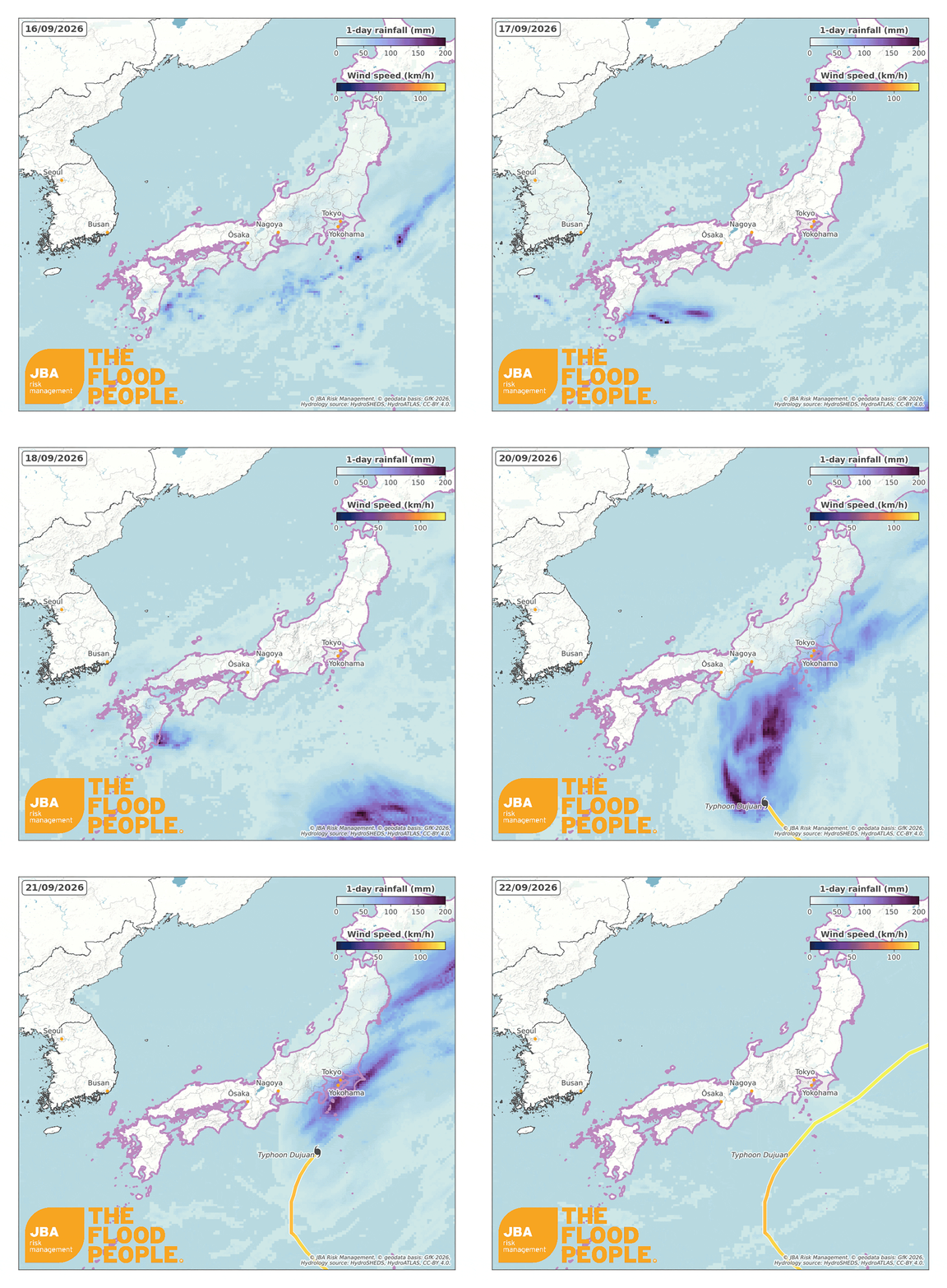
Figure 1
Figure 1: Animation of rainfall over Japan from 16 September to 22 September 2026. Rainfall data source: NASA GPM 3-hour rainfall accumulation (2026). Typhoon track data source: IBTrACS (2026). Animation produced by JBA Risk Management (2026).

Key impacts on the region

Communities along the eastern coast of Japan faced the most significant impacts from the typhoon, with evacuation orders issued for nearly 2 million people in low-lying coastal areas (SCMP, 2026). Fourteen fatalities were recorded in this event, with most deaths associated with landslides in Kanagawa and Chiba prefectures (Nippon.com, 2026a). The highest level of emergency warning was issued for tens of thousands of residents in low-lying areas along the Yoro River due to the risk of flooding (SCMP, 2026). 

Three embankment breaches were recorded around Lake Inbanuma, the largest lake in Chiba prefecture. The water level in the lake is typically regulated by discharging water into the Tone River in the north. However, the high water levels in the Tone River restricted drainage from the lake. The western section of the lake, connected to the Takasaki River, also overflowed, resulting in flooding at the Sakura railway station (The Japan News, 2026). It is estimated that at least 884 residential properties were flooded in Chiba prefecture (Nippon.com, 2026b).
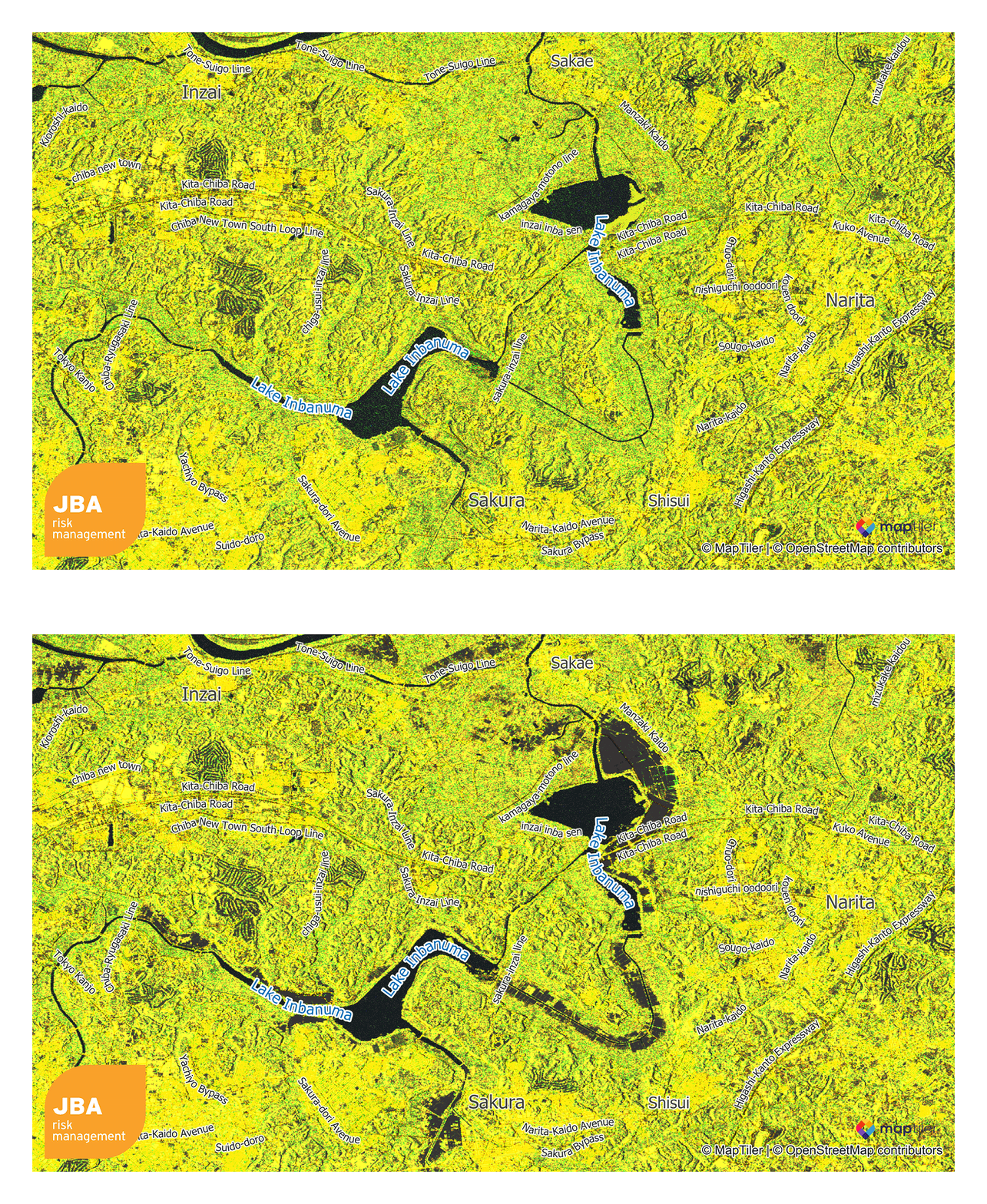
Figure 2
Figure 2: Sentinel-1 Interferometric Wide Swath (10 m x 10 m) Enhanced Visualisation imagery over Lake Inbanuma on 18 September and 24 September 2026 showing the increase in waterbody extent (dark blue/black) around Lake Inbanuma after the peak of the event on 21 September 2026. (Data source: ESA, 2026)

Daily life and travel were disrupted in several major Japanese cities as a result of the typhoon. Approximately 60,000 households in Tokyo and Chiba prefecture were without power in the immediate aftermath of the typhoon, with the power outage continuing to affect more than 45,000 households one day later (The Straits Times, 2026). More than 250 flights were grounded at airports and railway services between Tokyo and Chiba were suspended (SCMP, 2026). 

Flood and wind damage also interrupted major events hosted in Japan during the “Silver Week” national holiday. Matches and practice sessions at the Asian Games had to be rescheduled as the rain disrupted several competitions held across Nagoya in Aichi prefecture, Tokyo, and Osaka prefecture (The Japan Times, 2026a). One of the world’s largest video gaming conventions, Tokyo Game Show, cancelled the final day of event on 21 September 2026 for the safety of its attendees and exhibitors. The final day of performances of the Rock in Japan music festival in Chiba was also cancelled (BBC, 2026).

Notable historical events

Japan has experienced several significant flood events in recent years, driven by typhoons and prolonged periods of extreme rainfall. These events have resulted in widespread river flooding, urban inundation, landslides, and substantial disruption to communities and infrastructure. Typhoon Dujuan is consistent with several recent high-impact events that have affected the country, highlighting the recurring flood risk faced in densely populated regions and the importance of effective flood risk management. 

Japan flood table

Industry insight

Typhoon Dujuan is estimated to have caused USD $36 million in economic losses (The Japan Times, 2026b). This event highlights a key coverage gap in the Japanese insurance market. Unlike wind damage from typhoons, which is generally covered under standard Japanese property policies, flood coverage is often purchased separately. The proportion of Japanese households with flood coverage has decreased from 80% in 2013 to just over 60% in 2022 (Insurance Business, 2026). 

The event also occurred during a period of softening catastrophe reinsurance rates within Japan. Market reports highlight risk-adjusted price reductions of up to 20% in some Japanese catastrophe programmes during the April 2026 renewal season (Insurance Business, 2026). Typhoon Dujuan represents an important test of underwriting adequacy and catastrophe modelling assumptions across the Japanese market.

Conclusion

Typhoon Dujuan highlights the significant flood impacts that can result from prolonged typhoon-driven rainfall, particularly in densely populated regions. While no direct attribution to climate change has been established, the event is consistent with growing concerns regarding the increasing intensity of extreme rainfall events. The event demonstrates the importance of effective flood risk management to enhance resilience, reduce exposure, and mitigate future flood losses.

This report is accompanied by a flood footprint for the event, detailing extents and depths of the flooding in areas affected. Download it via our Client Portal or request a copy by emailing eventresponse@jbarisk.com. 

Join our mailing list

Never miss an update about our products and services, company news and event response data.

References

BBC, 2026. Four dead after powerful Typhoon Dujuan lashes Japan. [Online]. Available at: https://www.bbc.com/news/articles/cm3wj2lexl97o [Accessed 22 September 2026]

Channel News Asia (CNA), 2026. Typhoon Dujuan leaves four dead in Japan, 45,000 houses without power. [Online]. Available at: https://www.channelnewsasia.com/east-asia/typhoon-dujuan-japan-flights-evacuations-tokyo-6400821 [Accessed 2 October 2026]

Davies, R., 2023. Japan – 2 Dead, 4 Missing, Homes Destroyed After Tropical Storm Mawar Dumps Heavy Rain. [Online]. Available at: https://floodlist.com/asia/japantropical-storm-mawar-june-2023 [Accessed 2 October 2026]

European Space Agency (ESA), 2026. Sentinel-1 SAR image of the Chiba prefecture acquired on 2026-10-04 [satellite image]. Copernicus Data Space Ecosystem. [Online]. Available at: https://browser.dataspace.copernicus.eu [Accessed 4 October 2026]

Forward, J., 2023. Typhoon Mawar: Sweeping Rains Leave a Legacy of Death and Damage | JAPAN Forward. [Online]. Available at: https://japan-forward.com/typhoon-mawar-sweeping-rains-leave-a-legacy-of-death-and-damage/ [Accessed 2 October 2026]

GLOBE Task Team and others, 1999. The Global Land One-kilometer Base Elevation (GLOBE) Digital Elevation Model, Version 1.0. [Online]. Available at: https://www.ngdc.noaa.gov/mgg/topo/globe.html [Accessed 5 December 2025]

IBTrACS, 2026. The International Best Track Archive for Climate Stewardship. [Online]. Available at: https://www.ncei.noaa.gov/products/international-best-track-archive [Accessed 6 October 2026]

Insurance Business, 2026. Typhoon Dujuan exposes gaps in Japan’s property insurance cover. [Online]. Available at: https://www.insurancebusinessmag.com/asia/news/catastrophe/typhoon-dujuan-exposes-gaps-in-japans-property-insurance-cover-590853.aspx [Accessed 2 October 2026]

Kobayashi, C., Wakatsuki, Y. and Walsh, C., 2019. Typhoon Hagibis makes landfall in Japan, leaving at least 10 dead. [Online]. Available at: https://www.cnn.com/2019/10/12/asia/japan-typhoon-hagibis-intl-hnk [Accessed 2 October 2026]

Lehner, B., Messager, M. L., Korver, M. C., Linke, S., 2022. Global hydro-environmental lake characteristics at high spatial resolution. Scientific Data 9: 351. https://doi.org/10.1038/s41597-022-01425-z

Linke, S., Lehner, B., Ouellet Dallaire, C., Ariwi, J., Grill, G., Anand, M., Beames, P., Burchard‑Levine, V., Maxwell, S., Moidu, H., Tan, F., Thieme, M., 2019. Global hydro‑environmental sub‑basin and river reach characteristics at high spatial resolution. Scientific Data 6: 283. https://doi.org/10.1038/s41597-019-0300-6

NASA Global Precipitation Measurement (GPM), 2026. Precipitation Data Directory. [Online]. Available at: https://gpm.nasa.gov/data/directory [Accessed 6 October 2026]

Nippon.com, 2026a. Death Toll from Typhoon Dujuan Rises to 14 in Japan, A Week On. [Online]. Available at: https://www.nippon.com/en/news/yjj2026092800881/death-toll-from-typhoon-dujuan-rises-to-14-in-japan-a-week-on.html [Accessed 2 October 2026]

Nippon.com, 2026b. Over 800 Houses Inundated in Chiba Pref. Due to Typhoon. [Online]. Available at: https://www.nippon.com/en/news/yjj2026092400910/ [Accessed 2 October 2026]

South China Morning Post (SCMP), 2026. Japan begins clean-up after Typhoon Dujuan kills 4, batters east. [Online]. Available at: https://www.scmp.com/week-asia/health-environment/article/3368348/japan-begins-clean-after-typhoon-dujuan-kills-4-batters-east [Accessed 2 October 2026]

Storm Atlas, 2026. Typhoon Dujuan Track & Map Archive. [Online]. Available at: https://stormatlasx.com/storms/dujuan-2026 [Accessed 2 October 2026]

The Japan News, 2026. Heavy Rains Cause Levee to Break at Inbanuma Lake in Chiba Prefecture; Flooding Spreads to Homes, Rice Fields. [Online]. Available at: https://japannews.yomiuri.co.jp/society/general-news/20260924-350300/ [Accessed 2 October 2026]

The Japan Times, 2026a. Weather and transport woes hit Asian Games as Eala makes fast start. [Online]. Available at: https://www.japantimes.co.jp/sports/2026/09/29/asian-games/eala-asian-games-rain/ [Accessed 2 October 2026]

The Japan Times, 2026b. Storm menaces Japan after highest cyclone tally since 1966. [Online]. Available at: https://www.japantimes.co.jp/news/2026/09/25/japan/tropical-storm-surigae-japan/ [Accessed 5 October 2026]

The Straits Times, 2026. Typhoon Dujuan leaves four dead, 45,000 houses without power in Japan. [Online]. Available at: https://www.straitstimes.com/asia/east-asia/typhoon-dujuan-leaves-two-dead-46000-houses-without-power-in-japan [Accessed 2 October 2026]

Wakatsuki, Y. and Westcott, B., 2020. Japan floods kill at least 18 people after record-breaking rainfall. [Online]. Available at: https://www.cnn.com/2020/07/06/asia/japan-flooding-kumamoto-kagoshima-intl-hnk [Accessed 2 October 2026]

Related event responses

View all event responses

Muddy floodwater inundates a street between buildings, with debris and damaged materials scattered along both sides.

Catalonia floods: October 2026

3rd October

A slow-moving Mediterranean low, combined with abundant moist air and strong convective instability, produced exceptionally intense rainfall across Barcelona and eastern Spain on 3–4 October 2026. In places, rainfall totals exceeded 200 mm, with 3 October the wettest day in Barcelona's observed record.

Read more

House partially submerged by floodwater, with surrounding trees and utility poles also inundated.

Northeast US Floods: September 2026

23rd September

An unusually strong early-season nor’easter brought several days of coastal flooding, heavy rainfall, damaging winds and disruption to the northeastern United States in late September 2026. The slow-moving storm affected densely populated coastal communities from New Jersey to New England, with repeated high tides contributing to inundation of shorelines, bays and low-lying neighbourhoods.

Read more

Floodwater covering a residential street lined with houses and utility poles in Bangkok, Thailand.

Thailand floods: September 2026

16th September

In late September 2026, Bangkok experienced one of its most severe flood events in recent years after an exceptionally intense period of monsoon rainfall linked to a low-pressure weather system affecting mainland Southeast Asia.

Read more